Power quality analysis and management in smart buildings
It began with a flicker. At precisely 9:03 a.m., the lights in a high-end smart office tower dimmed for a second, barely noticeable to its occupants
Power quality analysis and management in smart buildings
It began with a flicker. At precisely 9:03 a.m., the lights in a high-end smart office tower dimmed for a second, barely noticeable to its occupants
But in the server room two floors below, the momentary dip triggered a cascade of system alerts. HVAC units briefly slowed, elevators paused, and automated lighting scenes reset across multiple zones.
Reviewing the Building Energy Management System (BEMS) dashboard, the building's facility manager traced the disruption to a brief voltage sag induced by the startup of a high-power EV charging bank in the basement. It wasn't a blackout nor a failure. It was a power-quality event—small in duration but significant in impact.
In modern smart buildings, where critical systems rely on continuous and conditioned power, minor Power Quality (PQ) disturbances can cause disruptions, equipment degradation, or data loss. Why do such anomalies persist in technologically advanced, automated environments? And more importantly, how can engineers identify, analyse, and mitigate these invisible yet damageing disturbances?
The answer lies in the complex power environment of smart buildings. With the integration of energy-efficient lighting, renewable sources, VFDs, IoT devices, and high-density electronics, buildings now both consume and generate power in nonlinear, dynamic ways. This leads to harmonics, sags, swells, transients, and unbalanced loads—each capable of compromising equipment performance and grid interaction if left unmanaged. This article explores the methodologies, technologies, and strategies for power quality analysis and management in smart buildings.
Power quality refers to the degree to which electrical power remains stable, clean, and within acceptable voltage, frequency, and waveform purity standards. It ensures that electricity delivered to equipment matches expected characteristics without spikes, dips, imbalances, or distortions. The key factors include voltage level, frequency stability, waveform shape, and phase balance. Power quality directly impacts electrical systems' performance, efficiency, reliability, and safety. Smart buildings face the following PQ challenges with

Video 1: Understanding Power Quality
PQ covers issues like wiring faults, voltage distortion, harmonics, and load fluctuations. These often go unnoticed but can silently damage equipment, causing overheating, failures, and early ageing. Distorted power stresses transformers and cables, leading to costly downtime, higher maintenance, and reduced equipment life. Common PQ issues in smart buildings include:
In addition to common power quality issues, smart building technologies introduce unique challenges such as islanding transients, reduced system inertia, bidirectional power flow, and electromagnetic interference, which require integrated and dynamic power quality management.
Figure 1: Common Power Quality issues
PQ analysis follows five key steps: identify the issue, choose the proper monitoring tools, install them strategically, analyse the data, and take corrective action.
Waveform analysis and data logging: Waveform analysis is key to detecting issues like voltage spikes, interruptions, and waveform distortions. Techniques such as Fast Fourier Transform (FFT) and wavelet transforms break down voltage and current signals into frequency components—FFT handles steady-state harmonics, while wavelets are ideal for spotting transients. Tools like MATLAB and PowerGUI (Simulink) support in-depth analysis.
Data logging in smart buildings continuously records power quality parameters, such as voltage, current, and frequency, to identify patterns, trends, and intermittent faults. This data is analysed against standards using metrics like THD and voltage sag duration, helping detect anomalies early.
Video 2: Power Quality – Essentials (Siemens)
PQ management in smart buildings involves a combination of mitigation technologies, system design, and operational strategies.
Active and passive harmonic filters: Active Harmonic Filters (AHFs) dynamically cancel harmful harmonics and correct power factors in real time by injecting counteracting currents, improving efficiency and extending equipment life. They adapt to changing loads using predictive algorithms and reduce reactive power losses. On the other hand, Passive Harmonic Filters (PHF) use capacitors and reactors to divert harmonics by offering a low-impedance path, providing a cost-effective solution when tuned to specific frequencies. On the other hand, sine wave filters smooth PWM outputs from VFDs to protect motors.
Figure 2(a): Triboelectric charging

Figure (b): Triboelectric charging
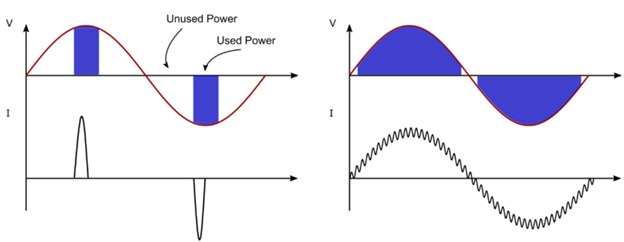
Figure 3: Low PF Power Transmission with No PFC (Left) and Power Transmission with Corrected Power Factor and PFC (Right)
Video 3: Power quality applications, measurements, and analysis (Megger)
Ensuring power quality in smart buildings requires adherence to key standards. IEEE 519-2022 sets limits for harmonic distortion at the Point of Common Coupling (PCC) and emphasises Total Demand Distortion (TDD) for real-world impact assessment. The IEC 61000 series provides global standards for electromagnetic compatibility and power quality measurement, with IEC 61000-4-30 defining precision requirements for Class A and S meters. EN 50160 outlines voltage characteristics delivered by public networks and highlights the need for coordination between utilities and building operators to address internal vs. external issues. ASHRAE 90.1, though focused on energy efficiency, indirectly affects power quality by promoting technologies like LEDs and VFDs that generate harmonics, underscoring the importance of integrating efficiency goals with power quality strategies for reliable building performance.
Integrating Distributed Energy Resources (DERs) and microgrids transforms power quality in smart buildings, introducing both disruptions and solutions. When paired with Battery Energy Storage Systems (BESS), intermittent sources like solar and wind help smooth output fluctuations and regulate voltage and frequency. Smart inverters (per IEEE 1547) and microgrid controllers play a critical role by manageing load balancing, seamless grid transitions, and real-time voltage control. While DERs can introduce issues like overvoltages and islanding transients, advanced control and storage systems turn them into assets for improving power quality, positioning smart buildings as active grid participants rather than passive consumers.
PQ analysis and management are integral to smart buildings' reliable and efficient operation. By using advanced monitoring tools, mitigation technologies, and data-driven strategies, engineers can address the challenges posed by complex electrical environments. Compliance with standards, integration with DERs, and adopting emerging technologies like AI and digital twins will further enhance PQ management, ensuring robust performance for mission-critical systems.
One of the greatest revolutions in all of human history! AI is an all-encompassing concept that incorporates human intelligence into machines
The #1 Destination for Embedded Evaluation Boards, Development Kits, and Tools
Explore our well-curated library of whitepapers, technical articles, videos, training modules, tutorials, and more to support you in developing your designs, business, and career