Energy Storage Solutions in Smart Buildings
Renewable energy sources like sunlight and wind are intermittent, producing power only when the sun shines or the wind blows
Energy Storage Solutions in Smart Buildings
Renewable energy sources like sunlight and wind are intermittent, producing power only when the sun shines or the wind blows
Such intermittency necessitates efficient energy storage systems to ensure a continuous and stable energy supply.
Acquiring energy storage capabilities allows building operators to increase demand flexibility, a crucial pillar of grid-integrated efficient buildings. This is important because buildings consume 40 per cent of global energy and produce 40 per cent of CO2 emissions. When one can store energy, one can control the timing and the amount of energy used or return it to the grid.
Buildings with energy storage systems can dynamically manage their energy consumption, preventing blackouts and supporting grid stability. Furthermore, energy storage increases building resilience by offering a backup power source during outages, ensuring the continuity of critical operations. The following are key reasons why energy storage is essential:
Various storage technologies are available for smart buildings based on how much energy they hold, how quickly they can supply power, how efficient they are, and how long they last.
BESS is a widely used electrochemical energy storage solution in smart buildings, storing electrical energy in chemical form for later use. These systems enhance energy efficiency and reliability by utilizing batteries composed of electrochemical cells, each containing an anode, cathode, electrolyte, and separator. BESS delivers economic benefits through reduced utility costs, promotes energy independence by decreasing grid reliance, and provides critical backup power during outages. The common battery types in Smart Buildings include:

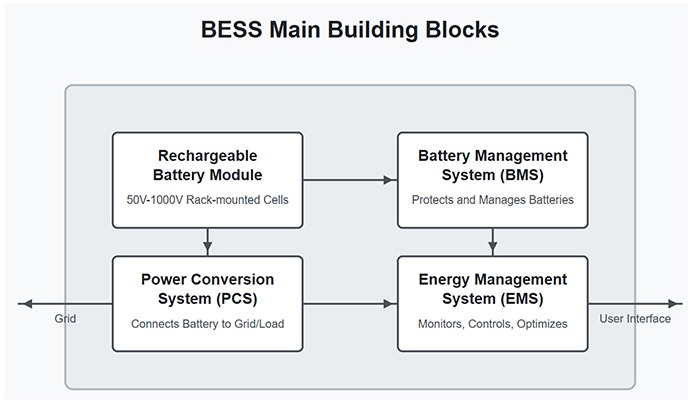
Figure 1: Block diagram of BESS
Fig 1 outlines the main building blocks of a Battery Energy Storage System (BESS), including the rechargeable battery module, battery management system (BMS), power conversion system (PCS), and energy management system (EMS) for efficient operation and control.
Mechanical energy storage systems use physical movement, pressure, or gravitational potential to store and release energy. These technologies are essential for balancing supply and demand in energy systems, especially in smart buildings and grid applications.
Pumped Hydro Storage (PHS): Pumped hydro storage is the most widely used mechanical energy storage method, accounting for the maximum amount of global electrical storage capacity. It relies on gravity to store energy by pumping water from a lower reservoir to a higher one during off-peak hours. When energy is needed, the water flows back down, driving turbines to generate electricity. In general, PHS systems offer high efficiency (70%-85%), large-scale storage capacity (1 MW to 3 GW), and a lifespan of over 40 years. Key applications include:
Compressed Air Energy Storage (CAES): CAES stores energy by compressing air at high pressure in underground reservoirs such as caverns or abandoned mines. When energy demand rises, the compressed air is released to power a gas-fired turbine, generating electricity. CAES provides large-scale energy storage (over 100 MW per unit) with a lifespan of around 40 years and an efficiency of about 70%. While CAES can store vast amounts of energy, its implementation depends on suitable geological formations. Key applications include:
Flywheel Energy Storage (FES): Flywheel energy storage converts electricity into rotational kinetic energy using a spinning mass (flywheel). During charging, a motor accelerates the flywheel; during discharge, the stored kinetic energy powers a generator. FES systems are highly efficient and have rapid response times. It is ideal for applications requiring short bursts of high power and frequent charge-discharge cycles. They feature low maintenance, long lifespan, high power density, and wide operating temperature ranges. Key applications include:
Electromagnetic energy storage systems use electric or magnetic fields to store and release energy efficiently. These systems offer rapid response times, long cycle life, and high power density, making them useful for short-term energy storage and power stabilization in smart buildings.
Capacitors store energy in an electrostatic field between two conductive plates separated by an insulating dielectric material. They charge and discharge quickly, allowing for high-power bursts, and have high efficiency and long cycle life without material degradation. However, their low energy density and high self-discharge limit their use in applications that require short-term power compensation. Capacitors are crucial for voltage regulation and power factor correction in smart buildings. Applications include:
Supercapacitors, also known as double-layer capacitors (DLCs) or ultracapacitors, store energy as static charge at the interface between an electrolyte and conductive electrodes. Their energy density is significantly higher than that of conventional capacitors (around 20 Wh/kg), and they can charge and discharge almost instantly. They are highly reliable, operate efficiently across a wide temperature range, and can last over 100,000 cycles without degradation. However, they suffer from high self-discharge rates (5%-40% per day) and high capital costs ($6000/kWh), limiting their use to short-duration applications rather than long-term energy storage. Applications include:
SMES systems store energy in a magnetic field generated by a superconducting coil carrying direct current (DC). Since the coil operates at cryogenic temperatures, it eliminates electrical resistance, ensuring high power density, ultra-fast response times (within milliseconds), and rapid charge/discharge cycles. With cycle efficiency between 85%-95% and a lifespan of over 30 years, SMES is one of the most efficient energy storage solutions. However, maintaining superconducting conditions requires a cryogenic cooling system, which results in high operational costs (up to $10,000/kWh) and self-discharge losses (10%-15% per day). Despite these drawbacks, SMES is highly effective in power quality control and grid stability applications. Applications include:
TES systems store electrical energy as heat in insulated containers using ice, wax, salt, or sand. These systems transform buildings into thermal batteries through storage media, refrigeration components, piping, pumps, and controls. TES captures energy from renewable sources for later use, addressing approximately 50% of building energy demand through space conditioning, water heating, and refrigeration. The technology comes in cryogenic and high-temperature varieties, reducing energy consumption while increasing load flexibility. The primary types of TES systems include:
Sensible heat storage: These systems store thermal energy by changing the temperature of a storage medium, such as water, rocks, or ceramics. As energy is added, the medium's temperature rises proportionally. Typical applications include hot water storage tanks and concrete thermal mass systems.
Latent heat storage: These systems use phase change materials (PCMs) to absorb or release large amounts of heat during phase transitions (e.g., from solid to liquid). This allows for efficient energy storage and release at nearly constant temperatures. For example, ice storage systems, where water freezes during low energy demand periods and melts to cool during peak times. Applications include:
Thermochemical storage: These systems use reversible chemical reactions to store and release thermal energy. It involves converting electricity into high-temperature heat, typically around 500°C. An electrical heater initiates the charging process, storing heat in materials like magnesium oxide bricks or molten salt. During discharge, the stored heat generates steam to drive turbines, producing electricity. This method is efficient for large-scale energy storage and often integrates with renewable energy sources. Applications in Smart Buildings include:
Figure 2: Methods of thermal energy storage: (a) sensible heat; (b) latent heat; (c) thermo-chemical storage
Energy storage in smart buildings does more than just save power—it transforms how we live. These systems actively manage energy use, boost efficiency, and promote the adoption of renewable energy sources, creating resilient and eco-friendly spaces. Technologies like predictive analytics, building automation, and real-time monitoring, help smart buildings to cut carbon footprints. As a result, it improves operations and enhance the quality of life for occupants.
One of the greatest revolutions in all of human history! AI is an all-encompassing concept that incorporates human intelligence into machines
The #1 Destination for Embedded Evaluation Boards, Development Kits, and Tools
Explore our well-curated library of whitepapers, technical articles, videos, training modules, tutorials, and more to support you in developing your designs, business, and career