Development kits have evolved from basic prototyping tools into full-featured platforms that accelerate product innovation across industries. Whether you're designing for industrial automation, smart homes, medical, or automotive markets, today’s dev kits empower engineers to go beyond proof-of-concept, enabling rapid testing, scalable development, and seamless integration with real-world systems.
The Product Development Journey: Challenges at Every Stage
From concept to commercial launch, every design faces hurdles. Here’s what today’s engineers are up against:
- Time-to-Market Pressure: Design cycles are shrinking. Competitive differentiation depends on speed, but traditional development processes are slow, especially when integrating security, connectivity, and compliance requirements.
- Fragmented Technology Landscape: IoT and edge computing projects involve multiple technologies like wireless stacks, encryption, ML models, RTOS, and cloud APIs. Getting them to work together takes time and expertise.
- Hardware Integration Complexity: Designing from scratch is risky and expensive. Engineers often spend months developing custom boards and chasing down layout bugs that could have been avoided.
- Regulatory and Certification Roadblocks: Whether it’s FCC, CE, UL, or ISO/IEC, certification is non-negotiable. Getting hardware to meet safety and EMI/EMC standards can derail timelines and budgets.
Why Development Kits Matter More Than Ever
With growing pressure to reduce time-to-market, shrink costs, and meet evolving connectivity and AI demands, design engineers are turning to high-performance development platforms that combine powerful hardware, robust software stacks, and pre-certified components.
The line between prototype and production is blurring. Increasingly, dev kits are engineered with full-stack functionality supporting edge AI, secure connectivity, advanced peripherals, and cloud integration out of the box.
Imagine designing an industrial automation controller or a connected medical device. With today’s kits, you're not just simulating functionality, you’re building on a foundation that can carry directly into production.
What’s changed?
- Faster Prototyping & Validation: Development platforms come pre-integrated with tested drivers, reference firmware, and debug tools, so developers can quickly validate ideas, test features, and iterate designs.
- Built-In Connectivity & Security: Many kits now include certified modules for Wi-Fi, Bluetooth, Matter, Thread, and secure boot. That means no extra work to integrate secure communications or encryption - it's ready to go.
- Accelerated Certification: Pre-certified wireless modules and SBCs (like Raspberry Pi Compute Module 5 or Arduino Portenta) reduce the burden of EMI/EMC testing, speeding up regulatory approval.
- Seamless Scaling from Dev Kit to Production: Platforms like NXP’s i.MX RT, or STM32 are available in both development boards and production-ready modules, allowing engineers to move from proof of concept to scalable hardware without redesign.
- Lower Risk & Cost: Dev kits eliminate early-stage design risks and reduce time spent on bring-up. SBCs like Raspberry Pi, Arduino Portenta, or AMD Ryzen Embedded offer robust ecosystems that simplify deployment for industrial and commercial applications.
From Concept to Production: Kits Leading the Way
Let’s explore how modern dev kits are redefining product design and the suppliers leading this transformation.
STMicroelectronics: From Rapid Prototyping to Secure AI-Driven Systems
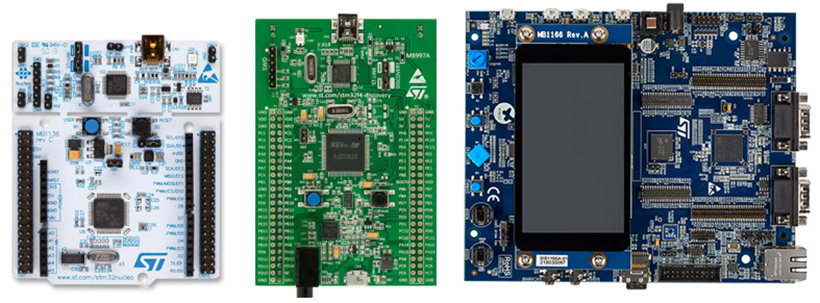
STMicroelectronics offers one of the most extensive and scalable embedded development ecosystems, built around the powerful STM32 and STM32MP1 platforms. Whether you're developing ultra-low-power wearables, industrial AI applications, or connected edge nodes, ST’s kits combine performance, flexibility, and robust software support.
- STM32 Nucleo Boards: A go-to platform for rapid development. These boards support a wide range of STM32 MCUs, from entry-level Cortex-M0+ to high-performance Cortex-M7 and M33. They're fully supported by the STM32Cube ecosystem, including STM32CubeMX for graphical configuration and STM32CubeIDE for code development and debugging.
- STM32 Discovery Kits: Ideal for evaluating key features like capacitive touch, USB, MEMS sensors, and audio processing. These boards offer a jumpstart into production-level hardware for specific application domains such as industrial control and wearables.
- STM32H7 and STM32H5 Series: Deliver high-speed performance (up to 550 MHz), advanced security features (including TrustZone® and Secure Boot), and extensive peripheral integration, perfect for edge AI, motor control, and data acquisition systems.
- STM32U5 Series: Offers ultra-low power performance with integrated AES, SHA, and secure storage, tailored for portable medical, wearables, and energy-sensitive IoT.
- STM32MP1 MPU Series: A hybrid platform combining dual-core Cortex-A7 with Cortex-M4, the STM32MP1 supports Linux + RTOS in a heterogeneous compute architecture, ideal for complex HMI systems, industrial gateways, and connected edge devices.
Explore STMicroelectronics STM32 Range ▶
Use Case Examples:
- In a smart wearable, the STM32L4 Nucleo board delivers ultra-low-power BLE operation for long battery life and real-time sensing.
- A robotics platform uses the STM32H7 Nucleo running STM32Cube.AI to execute TensorFlow Lite models directly at the edge.
- For a secure industrial control panel, the STM32H5 with TrustZone® and Secure Firmware Update enables IEC-compliant firmware protection.
- In a Linux-powered medical UI, the STM32MP157 Discovery Kit runs touchscreen interfaces and edge analytics with secure RTOS offload.
Challenge: Integrating secure AI and connectivity features on embedded platforms while keeping development cycles short.
Solution: ST’s STM32Cube.AI lets you deploy ML models directly to STM32 MCUs, while STM32CubeMX/IDE and X-CUBE middleware stacks (e.g., BLE, TLS, USB) streamline peripheral integration and security setup.
Design Insight:
- Use STM32H5/H7 for high-performance, secure, real-time AI applications.
- Choose STM32U5 when ultra-low power and built-in cryptography are required.
- Opt for STM32MP1 when you need Linux capability with MCU-level determinism on the same chip.
- Pair Nucleo or Discovery kits with X-NUCLEO expansion boards to test BLE, MEMS sensors, motor control, or cloud connectivity with minimal effort.
NXP: Edge Processing, Secure Control, and Scalable Platforms
NXP offers a robust portfolio of development kits that support everything from edge AI to real-time industrial automation, spanning high-performance application processors to energy-efficient MCUs.
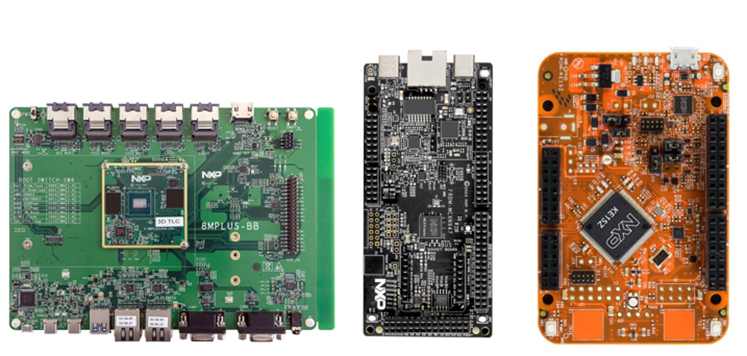
- i.MX 8M Plus EVK: With an integrated Neural Processing Unit (NPU), this kit enables real-time vision, speech recognition, and machine learning at the edge. Ideal for smart cameras and HMI systems, it eliminates the need for cloud inference.
- i.MX 9 EVK: Built for next-gen connected systems, the i.MX 9 series offers enhanced AI acceleration, advanced multimedia, and EdgeLock® security. It’s ideal for digital cockpit systems, connected healthcare, and industrial control.
- i.MX RT1060 EVK: A part of NXP’s “crossover MCU” family, this kit delivers the high-speed performance of application processors with the low-latency, real-time control of MCUs, perfect for predictive maintenance and motor control.
- MCX N Series Kits: Designed for scalable low-power applications, the new MCX N MCU kits offer advanced timer flexibility, integrated DSPs, and out-of-the-box Machine Learning (ML) enablement, making them perfect for smart edge nodes and IoT endpoints.
- Freedom Development Platforms (e.g., FRDM-K64F): These low-cost, feature-rich boards offer rapid prototyping for applications ranging from wearables to automotive interfaces. With Arduino-compatible headers and support for MCUXpresso IDE, they’re perfect for fast iteration.
Explore NXP i.MX, MCX and Freedom Platforms Range ▶
Use Case Examples:
- In a smart camera, the i.MX 8M Plus EVK enables on-device face detection with no cloud dependency.
- In a predictive maintenance system, the i.MX RT1060 captures high-frequency vibration data and performs local ML inference to detect faults.
- The i.MX 9 EVK enables high-performance inference and media processing in a connected healthcare gateway with advanced security.
- The MCX N Series powers an industrial sensor node, running local anomaly detection and transmitting only critical data via BLE to conserve energy.
Challenge: Bridging real-time control, high-performance ML, and system-level security.
Solution: NXP’s platforms support EdgeLock® security, TensorFlow Lite for MCUs, and scalable development tools such as MCUXpresso, simplifying integration across devices.
Design Insight:
- Use i.MX 8/9 series when high-performance multimedia, advanced connectivity, and edge AI are required.
- Opt for MCX or Freedom kits when prioritizing rapid prototyping, modular expansion, and low power.
- For hybrid workloads needing both control and compute, the i.MX RT crossover MCUs offer the best of both worlds.
Microchip: Power Efficiency, Scalable Connectivity, and Embedded Security
Microchip offers a diverse suite of development kits built around its SAM, AVR, PIC, and dsPIC families, backed by powerful tools like MPLAB X IDE, Harmony Framework, and Atmel START. Their kits enable fast prototyping and long-term support across automotive, industrial, and IoT markets.
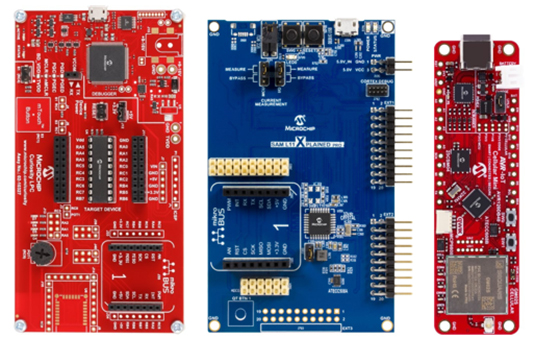
- Curiosity Nano Boards: Compact, USB-powered kits supporting SAM, AVR, and PIC MCUs. Ideal for ultra-low-power IoT, sensing, and wireless applications. Fully compatible with MikroBUS™ Click boards for modular expansion.
- SAM E70 and S70 Xplained Kits: Powered by Cortex-M7 cores, these platforms offer high-speed communication interfaces (CAN-FD, Ethernet) and are used widely in industrial motor control, gateway designs, and real-time data processing.
- dsPIC33CH Curiosity Development Board: Designed for digital power and motor control, this kit enables dual-core signal processing with robust PWM and ADC features.
- AVR-IoT Cellular and Wi-Fi Dev Boards: Out-of-the-box connectivity to Google Cloud or AWS IoT, with secure element integration for TLS and authentication.
- PIC32MX and PIC32MZ Curiosity Boards: Designed for high-performance audio, USB, and graphics applications with robust MPLAB Harmony middleware support.
Explore Microchip Curiosity, AVR and SAM Range ▶
Use Case Examples:
- A smart irrigation controller built on SAM L21 Curiosity Nano uses ultra-low-power sleep modes and weatherproof capacitive touch UI.
- A motor drive controller uses SAM E70 Xplained to handle real-time diagnostics and control over CAN-FD.
- A connected energy meter leverages AVR-IoT Cellular Kit to send data securely to the cloud, with hardware-based authentication.
Challenge: Managing low power, connectivity, and secure communication in embedded applications.
Solution: Use MPLAB Harmony with pre-built drivers and secure libraries. Integrate CryptoAuthentication™ devices (e.g., ATECC608) to enable secure boot, TLS, and cloud identity.
Design Insight:
- Start with Curiosity Nano kits for fast proof-of-concept work.
- Use MPLAB Code Configurator (MCC) to auto-generate peripheral configuration and middleware.
- Consider dsPIC kits for applications requiring DSP-level control like digital SMPS or sensor fusion.
AMD: High-Performance Platforms for Embedded Vision and Edge AI
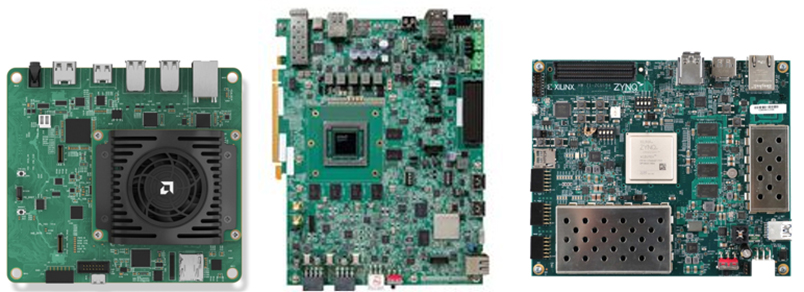
AMD’s embedded development platforms deliver unmatched performance for real-time AI, machine vision, and high-throughput control applications. With its acquisition of Xilinx, AMD now offers the Versal™, Kria™, and Zynq UltraScale+™ families, integrating programmable logic with ARM-based processing.
- Kria KV260 Vision AI Starter Kit: A plug-and-play platform for deploying computer vision models at the edge. Supports out-of-the-box acceleration using Vitis AI and pre-trained DNNs for use cases like surveillance and traffic analytics.
- Versal AI Edge Kits: Deliver adaptive computing capabilities for robotics, medical imaging, and industrial automation, with hardware programmability for real-time inferencing.
- Zynq UltraScale+ MPSoC Kits: Blend quad-core ARM Cortex-A53, dual-core Cortex-R5, and FPGA fabric, ideal for deterministic workloads with rich media and control needs.
- Ryzen Embedded V3000: Delivers x86 performance for industrial PCs, edge servers, and instrumentation with a focus on thermal efficiency and long lifecycle.
Explore Kria, Versal, Zynq and Ryzen Range ▶
Use Case Examples:
- A smart traffic camera system uses Kria KV260 for real-time video analytics with low latency and no cloud dependency.
- A robotic surgery assistant leverages Versal AI Edge to process sensor fusion and AI vision workloads in parallel.
- An industrial edge gateway uses Ryzen Embedded to run high-throughput control software with Linux and containerization support.
Challenge: Running compute-intensive AI inference and deterministic control on a single platform.
Solution: Use Vitis/Vitis AI toolchains to build hybrid applications that utilize both FPGA acceleration and ARM processing. Leverage PYNQ for Python-based development on programmable logic.
Design Insight:
- Choose Versal and Zynq kits when your application requires low-latency, hardware-adaptable acceleration.
- Opt for Ryzen Embedded when you need modern OS support, containerized workloads, and high-speed peripheral support.
Raspberry Pi: Industrial-Grade Platforms for Automation and Edge Control
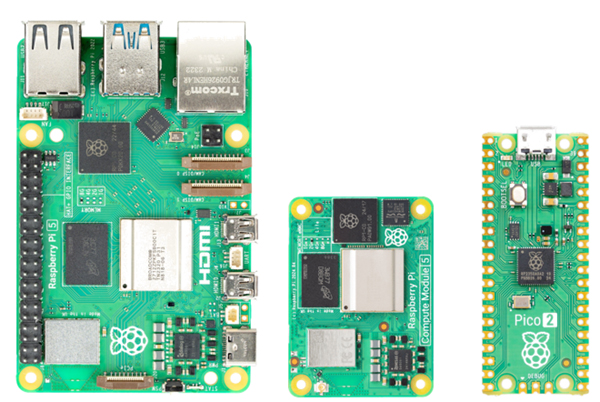
Once a platform for hobbyists, Raspberry Pi has matured into a versatile foundation for industrial automation, edge computing, and home automation. With platforms like the Compute Module 5 (CM5) and Pico 2, Raspberry Pi now offers scalable, production-ready hardware with long-term availability, rich I/O, and robust community support.
- Compute Module 5 (CM5): Built on the Raspberry Pi 5 architecture, CM5 delivers quad-core Arm Cortex-A76 performance, PCIe Gen 2, dual HDMI, MIPI CSI/DSI, and onboard eMMC storage. It's designed for industrial integration in smart gateways, HMI panels, and control nodes.
- Raspberry Pi 5: An SBC featuring up to 8GB RAM, USB 3.0, PCIe, and dual-display output, Raspberry Pi 5 supports full-fledged Linux environments for rapid UI prototyping or local data processing.
- Raspberry Pi Pico 2: A next-generation microcontroller board with dual-core Arm Cortex-M0+, Wi-Fi 5 (802.11ac), and upgraded onboard flash. Perfect for low-power automation nodes, sensor endpoints, or actuator control in smart homes and buildings.
- CM5 IO Board: Breaks out high-speed interfaces including USB, Ethernet, HDMI, and PCIe, simplifying early-stage development and industrial testing.
Explore Raspberry Pi Full Ecosystem ▶
Use Case Examples:
- A factory automation system uses Compute Module 5 in DIN-rail-mounted gateways for edge protocol conversion and local HMI visualization.
- A building energy management solution leverages the RPi 5 to aggregate HVAC sensor data and control schedules via Modbus over TCP.
- A home automation controller uses Pico 2 to operate relays, lights, and environmental sensors over Wi-Fi, with OTA update support and ultra-low idle power.
Challenge: Bridging the gap between proof-of-concept builds and certified, reliable industrial deployment.
Solution: Use CM5 for embedded products requiring industrial interfaces, extended I/O, and longevity. Develop in Raspberry Pi OS, Yocto, or Ubuntu Core for secure, updatable deployments.
Development Strategy:
- Use Pico 2 where cost, size, and power efficiency matter, ideal for sensor networks and smart device controllers.
- Deploy CM5 when you need high-speed processing, multimedia support, or ruggedized deployment in edge environments.
- Choose Raspberry Pi 5 for lab testing, user interface prototyping, or small-scale deployment where Linux applications are central.
Arduino: Open Innovation for Professional Applications
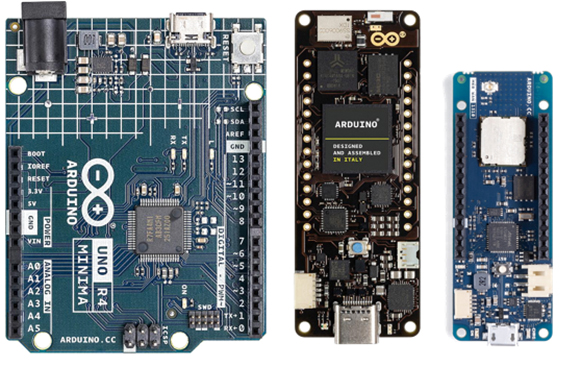
Arduino’s ecosystem now supports professional, scalable development with its Portenta, Nicla, and MKR families. Combining the ease of the Arduino IDE with industrial-grade features, these platforms are increasingly used in logistics, environmental sensing, and edge computing.
- Portenta H7: Dual-core ARM Cortex-M7/M4 MCU, supporting Wi-Fi, BLE, USB, and LoRa. Great for logistics tracking, machine monitoring, and remote diagnostics.
- Nicla Sense ME: Ultra-compact sensor board with Bosch sensors and onboard microcontroller, ideal for high-fidelity sensing and local AI processing.
- Nicla Vision: Combines image sensing and AI inference in a tiny package, targeting low-power computer vision at the edge.
- MKR Family: Modular boards offering cellular, LoRa, NB-IoT, and Sigfox connectivity with Arduino simplicity.
Explore Arduino Portenta, MKR and Nano Range ▶
Use Case Examples:
- A cold-chain logistics company uses Portenta H7 + LoRa for pallet tracking with long-range connectivity and real-time sensor data.
- An air quality monitoring station leverages Nicla Sense ME to track environmental conditions and send alerts via BLE.
- A smart parking sensor uses Nicla Vision to detect vehicle presence and update the cloud dashboard.
Challenge: Scaling from simple PoCs to reliable industrial deployments.
Solution: Arduino’s Pro IDE, open-source libraries, and Python/Edge Impulse integration offer scalable development paths. The hardware is built to industrial specs with CE/FCC certification where needed.
Design Tip:
- Start with Nicla boards for sensor-rich, AI-on-the-edge applications.
- Use Portenta H7 when advanced connectivity and dual-core performance are required.
- For networked applications, leverage MKR boards with the Arduino Cloud or your preferred IoT stack.
Partnering for Innovation
At Farnell, we support engineers at every step from initial evaluation to full-scale deployment. Our extensive portfolio includes dev kits from STMicroelectronics, NXP, Microchip, Raspberry Pi, Arduino, AMD and many more industry-leading suppliers along with the tools, documentation, and support to move fast and build with confidence.
Ready to innovate beyond prototyping? Explore our latest development kits and design resources at the Farnell Technical Resources Hub, including solution guides, articles, whitepapers, and the AI Hub, to gain valuable insights and stay ahead of the curve. Stay ahead with our latest issue of e-TechJournal.
Let’s build what’s next - together.


Technologies





Artificial Intelligence
One of the greatest revolutions in all of human history! AI is an all-encompassing concept that incorporates human intelligence into machines
DEVKIT HQ
The #1 Destination for Embedded Evaluation Boards, Development Kits, and Tools
IoT Sensor to Cloud Platform
/IOTCONNECT™ accelerate your loT journey with secure, ready-to-use cloud connectivity
Further Resources
Calculators & Conversion Charts
Selection Guides and Catalogues
Essential Learning Modules
Tech Spotlights
Design Resources
Engineering Glossary
Technical Support
Parts Finder Tools
