Advancing hygienic level measurement
Radar solutions for Food, Beverage, and Life Sciences Industries,Life is the most valuable thing in this world for any living creature
Advancing hygienic level measurement
Radar solutions for Food, Beverage, and Life Sciences Industries,Life is the most valuable thing in this world for any living creature

Therefore, high-stakes environments like the food & beverages (F&B), and life sciences industries demand a high degree of precision, as there is no tolerance for error. Consumer safety, operational efficiency, and product regulatory compliance are non-negotiable here, as even the slightest deviation can compromise outcomes or violate stringent regulations. Standards like 3A, EHEDG, and FDA govern the hygienic environment to ensure contamination-free production and product integrity.
Within this landscape, one of the key processes is level measurement. Accurate level monitoring ensures process efficiency and prevents overfills or dry runs. It also conforms to safety standards and guarantees operational safety. However, precise level measurement must contend with disturbances such as turbulent conditions, viscous media, or varying material properties. But how can industries achieve this precision in sterile settings without risking contamination or compromising reliability?
Find the answer in this article, which explores radar-based level measurement solutions specially designed for hygienic applications.
Radar technology has been used in defence and aerospace for years, but it has expanded its reach to hygienic industrial environments such as food & beverages (F&B), and life sciences. A popular example of this is the radar-based level transmitter. It is a non-contact method for determining the amount of a liquid or solid within a container. A radar transmitter system comprises an antenna, an operating interface, a signal processor, a receiver, and an in-built oscillator.
Radar level transmitters for closed tanks are generally based on two technologies: time of flight (ToF) and frequency modulated continuous waveform (FMCW). In FMCW, the transmitter continuously emits a high-frequency pulse towards the surface of the medium. This pulse is reflected from the medium and received by the receiver. The level of the medium in the tank is measured by calculating the shift in frequency between the transmitted and reflected wave.
In the case of ToF radar, the time taken by the pulse to travel from transmitter to receiver is calculated to measure the level.
However, both technologies are almost similar, except for the method used to calculate the distance (level).
Another important consideration when selecting a radar level sensor is the beam angle. This parameter tells you how close the radar level transmitter can be installed to the tank wall. The beam should never reach the tank wall, because it can interfere with the radar signal and may give inaccurate measurements.
The wider the beam, the lower the amplitude of the emitted signal that returns to the receiver of the level sensor after reflecting from the surface of the material inside the tank. Wide beams are more sensitive to obstacles within a tank and susceptible to interference from tank walls -especially in tanks that contain baffles, heat coils, or agitation.
Additionally, foaming within the vessel media or buildup accumulation on the radar antenna can interfere with the reflected signal and cause measurement inaccuracies.
On the other hand, transmitters with narrow beams offer promising measurement results with higher sensitivity. A narrow beam also simplifies the installation of the level transmitter on the tank. It allows the instrument to be installed close to the tank wall, making it easier to avoid obstacles and enabling more convenient service and maintenance.
Frequency is another factor that affects the beam angle of the signal emitted by the transmitter. Lower frequency transmitters generate wider beam angles, while higher frequency transmitters generate narrow beam angles. However, a wide beam angle may still be more suitable than a narrow one in some applications.
Figure 1: Relation between Beam angle and frequency in radar level measurement
There is much discussion regarding the frequency of the radar transmitters. Some manufacturers claim that the higher the frequency, the better the performance. Is this true? Perhaps not. Accuracy depends upon a combination of frequency, beam angle, antenna configuration, installation, and also the dielectric constant of the product itself. Table 1 provides a broader picture of the strengths and weaknesses of different operating frequency bands for radar-level transmitters.
| Strengths | Weaknesses | |
|---|---|---|
| Low Frequency : 6-11 Ghz |
|
|
| Mid Frequency : 24-29 Ghz |
|
|
| High Frequency : 75-85 Ghz |
|
|
Table 1: Strengths and weaknesses of different operating frequency bands for radar-level transmitters
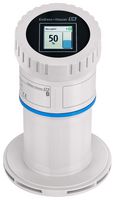
Endress+Hauser's radar level measuring device, Micropilot FMR43, helps attain faster measuring speeds, allowing maximum accuracy even in media with turbulent surfaces. It can be used in the smallest containers and cover measuring ranges of up to 15 meters. It comes with integrated Heartbeat Technology that provides diagnostics, verifies performance, and monitors all process data for predictive maintenance and process optimisation strategies. For example, with Heartbeat Monitoring technology, foam can be detected on the medium, and anti-foam agents can be used on demand.
With Heartbeat Technology and the Radar Accuracy Index (RAI), traceable verification in accordance with DIN ISO 9001 is possible. In addition, the device includes state-of-the-art model-based firmware that has been specially adapted to the typical challenges in small bioreactors, such as polished surfaces and foaming.
Micropilot FMR43 can be readily integrated into all process units and skids used for the production and purification of biotherapeutics or other life sciences products. It is also ideal for various applications in the food industry, especially in narrow installation situations, such as those often found in skids for milk and beverage processing.
Continuous level measurement in the food and beverage and life-science industries can be challenging. Frequency-modulated continuous waveform-based radar transmitters can meet these challenges by offering an accurate and reliable solution that enables improved product quality, increased production capabilities and throughput, and reduced waste. Farnell offers a broad portfolio of level transmitters from established manufacturers with IIoT-ready and versatile digital connectivity. that helps companies protect their products, optimise their processes, and build a foundation of safety and quality that customers can trust.
One of the greatest revolutions in all of human history! AI is an all-encompassing concept that incorporates human intelligence into machines
The #1 Destination for Embedded Evaluation Boards, Development Kits, and Tools
Explore our well-curated library of whitepapers, technical articles, videos, training modules, tutorials, and more to support you in developing your designs, business, and career