However, these systems encounter significant thermal challenges that can hinder their performance and reliability. Overheating, caused by high-powered lasers and environmental factors such as solar loading, necessitates advanced thermal management solutions. This article delves into how Gallium Nitride (GaN), a wide-bandgap semiconductor, provides enhanced thermal conductivity and efficiency, offering a reliable solution to improve the range and resolution of LiDAR systems. Through the integration of GaN technology, LiDAR systems can achieve increased power output, improved signal-to-noise ratio, and efficient thermal management, paving the way for more accurate and dependable autonomous applications.
Thermal challenges in LiDAR systems
LiDAR systems often overheat due to their high-powered lasers, which convert only 10% of input energy into laser output, with the rest turning into heat. This heat buildup is worsened by solar loading when used outdoors, making thermal management a critical challenge. Addressing these thermal challenges is crucial for maintaining the efficiency and reliability of LiDAR systems. Key factors contributing to these overheating issues include:
- Laser diode temperature: Excessive heat reduces the laser diode’s performance, causing wavelength shifts, reduced output, and faster degradation. Cooling mechanisms like TECs (Thermoelectric Cooling) or heat sinks are essential to maintain optimal temperatures.
- Detector temperature: Detectors like APDs (Avalanche Photodiodes) or SPADs (Single-Photon Avalanche Diodes) suffer from thermal noise, which lowers SNR and affects accuracy. Stable temperatures are crucial for high-performance detection.
- Optical component temperature: Temperature changes affect lenses, mirrors, and beam splitters, causing beam distortion and misalignment. Passive or active cooling solutions are needed to keep components within specified ranges.
- Electronic component temperature: Heat affects processors, FPGAs (Field Programmable Gate Array), and ADCs (Analog to Digital Converters), degrading performance and risking damage. Effective heat dissipation through heat sinks, forced air, or liquid cooling is necessary.
- Environmental thermal conditions: Extreme temperatures and direct sunlight stress thermal management, risking performance and system failures. Robust thermal design and environmental protection ensure reliable operation.
How GaN improves thermal management in LiDAR systems
GaN, a wide-band gap semiconductor, offers superior thermal conductivity to traditional silicon (Si). It is ideal for high-power and high-frequency applications and for addressing thermal challenges in LiDAR systems. Here’s how GaN keeps things cool in three critical areas:
- Laser Diode Cooling: GaN-based High-Power Laser Diodes enhance LiDAR systems with longer-range detection and lower heat output than traditional materials. Their superior thermal conductivity enables efficient heat dissipation, minimizing the need for bulky cooling systems and allowing for more compact, lightweight designs. GaN laser diodes can also integrate Thermoelectric Coolers (TECs) on the same substrate for localized thermal management, ensuring optimal operating temperatures by enhancing heat transfer and cooling performance.
- Detector Cooling: GaN-based APDs (Low-Noise Avalanche Photodiodes) offer lower noise levels due to their wide bandgap and high thermal conductivity, improving the signal-to-noise ratio (SNR) and ranging accuracy in LiDAR systems. Efficient heat dissipation, achieved through integrated or external cooling, enhances detector performance. GaN APDs, like laser diodes, can be integrated with TECs or other cooling mechanisms on the same substrate. This ensures localized, efficient cooling, minimizes thermal noise, and maintains optimal operating temperatures.
- Power Electronics and Drivers: GaN-based power electronics and drivers in LiDAR systems operate at higher power densities and frequencies than silicon-based devices. GaN's high thermal conductivity allows better heat dissipation, enabling more compact and efficient designs. For efficient passive cooling, GaN devices can integrate with high-thermal-conductivity materials like diamond or Aluminium Nitride (AlN). These solutions effectively dissipate heat from power electronics and drivers, reducing the need for bulky active cooling systems.
Thermal management strategies with GaN
Several thermal mitigation strategies are available to maximize GaN's heat dissipation advantages in LiDAR applications.
- Integrated GaN-based System-on-Chip (SoC): Monolithic integration of GaN-based laser diodes, detectors, power electronics, and drivers on a single SoC enables efficient thermal management with localized cooling solutions. This minimizes thermal crosstalk and simplifies the overall thermal design of LiDAR systems.
- Advanced Packaging Techniques: Flip-chip bonding, thermal vias, and high-thermal-conductivity substrates optimize heat dissipation from GaN components. These techniques facilitate effective heat transfer to external cooling solutions like heat sinks or liquid cooling systems.
- Thermal Modeling and Simulation: Accurate thermal modelling and simulation tools help optimize the thermal design of GaN-based LiDAR systems by identifying potential hotspots, optimizing component placement, and evaluating the effectiveness of various cooling solutions.
GaN-powered LiDAR- Enhancing detection and imaging accuracy
GaN technology revolutionizes LiDAR systems, crucial for self-driving cars and environment sensing, by offering ultra-fast switching and high-current pulsing needed for precise time-of-flight measurements. Unlike traditional silicon transistors, GaN transistors switch up to 100 times faster, handle higher currents, and have near-zero parasitic inductance, enabling ultra-short, powerful laser pulses. Advanced GaN ICs integrate laser drivers and gate drives, eliminating interconnect parasitics and achieving pulse rise times as short as 20 picoseconds with currents up to 125 A. This advancement supports long-range, high-resolution imaging and unique pulse-coding techniques to mitigate signal noise, which are essential for autonomous vehicles and high-precision applications.
1. Enhancing Range with GaN-based Laser Diodes:
GaN technology significantly enhances the LiDAR range by enabling higher power output, improved signal-to-noise ratio (SNR), and efficient power management. The key benefits include:
- Superior Handling of Voltage and Current: GaN transistors handle higher voltage and current levels, achieving power densities up to 10 W/mm, compared to about 1 W/mm for silicon devices, thus allowing more powerful laser pulses.
- Improves SNR: They also improve SNR by up to 3 dB, doubling the range for the same transmitted power.
- High Efficiency: GaN transistors operate at efficiencies above 90% versus 70-80% for silicon, reducing energy losses and directing more power into the laser pulse.
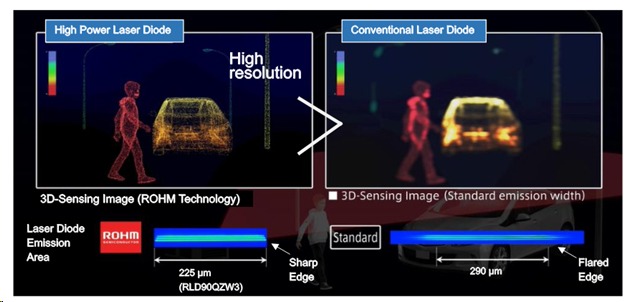
Figure 1: Illustration of using a GaN laser diode (Source)
2. Enhancing Resolution with GaN FETs and High Electron Mobility Transistors (HEMTs):
GaN technology boosts LiDAR resolution by enabling faster switching speeds, higher frequency operation, and improved thermal stability. The key benefits are:
- Faster Switching Speeds: GaN transistors can switch up to 200 MHz, compared to 50 MHz for silicon. This allows for 1 ns pulse widths and higher pulse repetition rates.
- Higher Frequency Operation: GaN devices operate at frequencies up to 100 GHz, compared to 20-30 GHz for traditional systems. GaN enhances time-of-flight measurements, yielding finer spatial resolution and detailed point clouds.
- Improved Thermal Stability: GaN devices maintain performance up to 300°C, ensuring consistent, reliable resolution across varying conditions.
To generate light pulses for LiDAR, semiconductor switches drive lasers. The quality of these switches, defined by turn-on time, peak current, and switching loss, directly impacts the LiDAR image resolution. GaN-based High Electron Mobility Transistors (HEMTs) excel in this role. Compared to traditional silicon devices, GaN HEMTs offer ultra-fast speeds and up to 65% lower power loss. GaN HEMTs are available at various operating voltages and power levels for high-power LiDAR applications. ROHM Semiconductor offers GaN HEMTs in 150 V and 650 V models, providing robust options for diverse LiDAR systems.
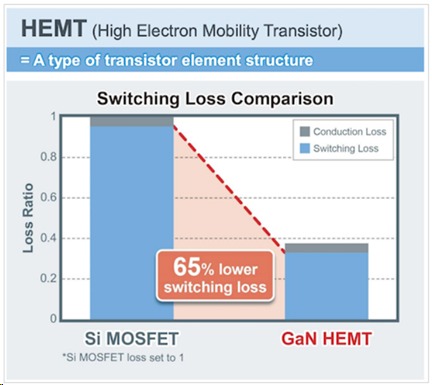
Figure 2: GaN HEMT switching loss compared to traditional silicon transistors (Source)
3. Enhancing LiDAR precision with smarter tech:
Combining GaN devices' superior switching capabilities enhances LiDAR's distance resolution and measurement range. Unlike conventional silicon, GaN can drive lasers with ultra-fine 1ns pulses, enabling precise distance sensing. This 1ns shift equates to a 30cm distance gap, which thicker pulses can't achieve. Additionally, shorter current flow times generate less heat, allowing higher currents for longer-distance measurement.
Warehouse automation with GaN-enhanced LiDAR
Warehouse automation is transforming logistics by boosting efficiency and reducing manual labour. Automated Guided Vehicles (AGVs) and Autonomous Mobile Robots (AMRs) are central to this shift, relying on advanced LiDAR for navigation, obstacle detection, and precision. GaN technology significantly enhances LiDAR performance in these applications. Critical improvements with GaN-based LiDAR systems include:
- Higher power output: GaN transistors handle more voltage and current, extending the LiDAR range for better obstacle detection in large warehouses.
- Faster switching: GaN's rapid switching allows shorter, frequent laser pulses, improving resolution for detecting smaller objects and details.
- Higher frequency: GaN supports higher frequency operations, enhancing time-of-flight accuracy for precise mapping and navigation.
- Better thermal management: Superior thermal performance ensures consistent, reliable operation, reducing downtime and maintaining efficiency.
- GaN-enhanced AGVs in warehouse operations: A large e-commerce fulfilment centre implemented GaN-based LiDAR systems in their AGVs to boost navigation accuracy and obstacle detection. The result was a 40% improvement in navigation precision and a 25% increase in operational speed. Enhanced range and resolution reduced collisions by 30% and increased overall throughput by 20%, significantly improving warehouse efficiency.
- Safeguarding logistics systems with functional safety: LiDAR is crucial for safe human-machine collaboration in logistics, meeting ISO functional safety standards. For outdoor use, laser diodes must resist the effects of sunlight. GaN-powered laser diodes have low wavelength temperature dependence and, paired with a narrow sunlight cut filter, minimize noise and extend detection range. These intelligent sensing solutions enable higher performance in AMRs, enhancing efficiency and safety in intelligent logistics systems.
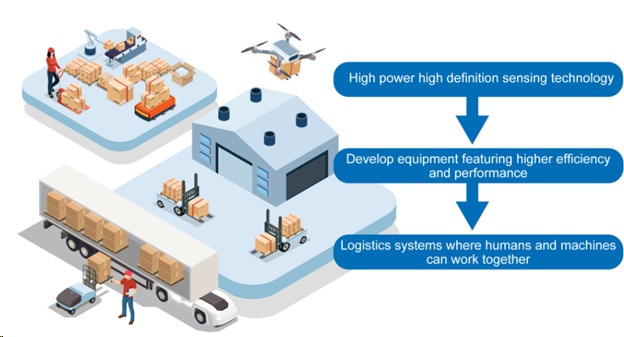
Figure 3: A logistics system with assured functional safety (Source)
Conclusion
GaN technology is revolutionizing LiDAR systems by improving thermal conductivity and efficiency. It enhances performance, allowing for longer range, higher resolution, and more precise detection. This technology is essential for applications like autonomous vehicles and warehouse automation, enhancing operational efficiency and ensuring safer implementation in high-precision applications, marking a significant advancement in intelligent logistics and autonomous technologies.
As a global distributor, we offer a wide range of products, including semiconductors (Discrete and ICs), Power Management ICs (PMIC), development boards, and evaluation tools for diverse industrial settings.



Tecnologías
Inteligencia artificial
¡Una de las más grandes revoluciones en la historia de la humanidad! La inteligencia artificial es un concepto integral que incorpora la inteligencia humana a las máquinas
DEVKIT HQ
The #1 Destination for Embedded Evaluation Boards, Development Kits, and Tools
IoT Sensor to Cloud Platform
/IOTCONNECT™ accelerate your loT journey with secure, ready-to-use cloud connectivity





Further Resources
Calculators & Conversion Charts
Selection Guides and Catalogues
Essential Learning Modules
Tech Spotlights
Design Resources
Engineering Glossary
Technical Support
Parts Finder Tools
