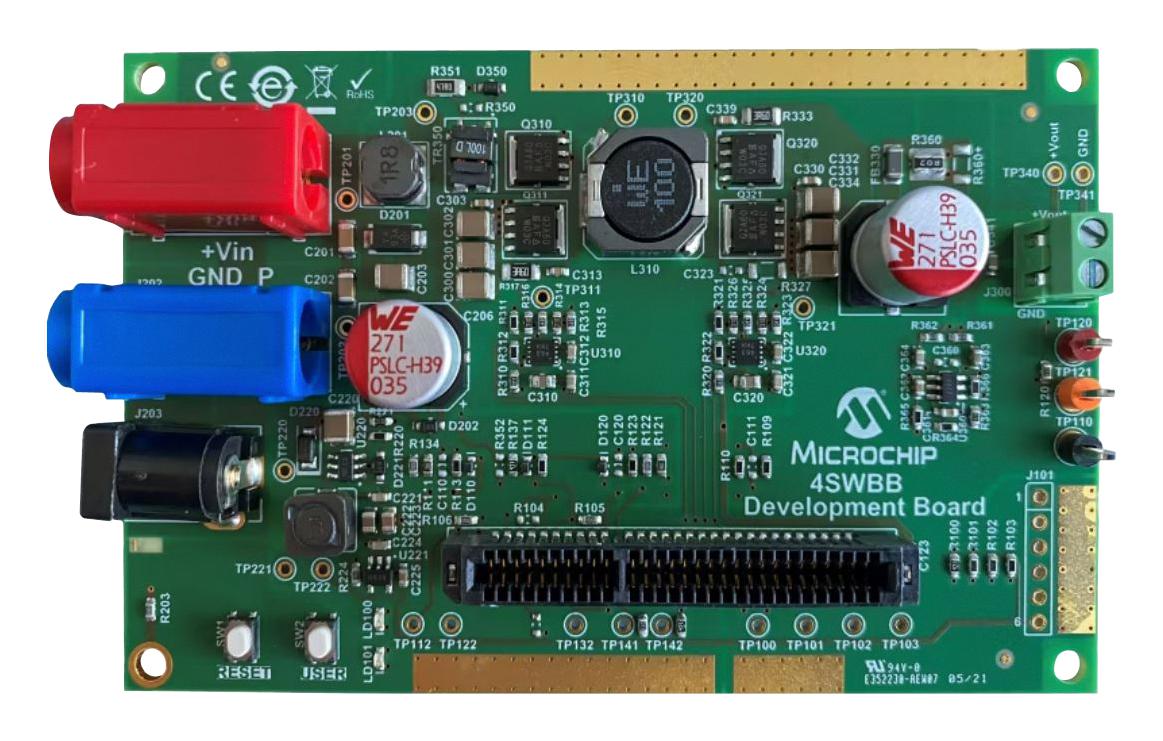
Microchip DV330101 Low Voltage Power Factor Correction (LVPFC) Development Kit
Develop efficient digital power factor correction solutions with DV330101, leveraging dsPIC33EP, interleaved boost topology, and advanced power control algorithms.

Develop efficient digital power factor correction solutions with DV330101, leveraging dsPIC33EP, interleaved boost topology, and advanced power control algorithms.

The DV330101 Low Voltage Power Factor Correction (LVPFC) Development Kit from Microchip provides a hands-on platform for evaluating efficient digital power factor correction and advanced power control designs using the dsPIC33EP128GS806 MCU. Built around a conventional interleaved boost PFC topology, the hardware supports 24 VAC input but is designed following high-voltage PCB rules, allowing modification for universal offline voltage ranges of 80–260 VAC with outputs up to 200 W.
The kit enables engineers to safely develop and test PFC algorithms on a boost topology at moderate power levels before applying them to real-world systems. Key hardware blocks include an EMI/EMC input filter, bridge rectifier, dual-phase MOSFET stages with current transformers and diode rectifiers, and an Ultra-Wide Voltage Range (UWVR) 5 W flyback with 12 V primary and secondary rails (4 kV galvanic isolation).
The LVPFC kit also includes an isolation transformer (10:1 turns ratio) and a 50 W active load, available through third-party providers like ASCALAB, supporting comprehensive experimentation and algorithm validation. With full digital control capability, the kit is ideal for prototyping and accelerating development of power electronics applications in low- and medium-voltage systems.
The DV330101 Low Voltage PFC Development Kit offers a unique combination of safety, advanced digital control, modularity, and comprehensive support, making it an excellent choice for engineers and developers aiming to design efficient and reliable power factor correction systems.
Here's how it differentiates itself from other development kits:
Safe Low-Voltage Development: Operates at 24 VAC input, providing a safe platform to prototype and test PFC designs, unlike high-voltage kits that pose safety risks.
Advanced Digital Control: Powered by the dsPIC33EP128GS806 MCU, it enables precise, full-digital PFC algorithms for high efficiency and optimized performance.
Modular DP PIM Design: Digital Power Plug-In Module (DP PIM) allows easy swapping of modules to test different control strategies without redesigning hardware.
Comprehensive Tools & Features: Includes interleaved boost PFC, EMI/EMC filters, bridge rectifier, flyback converter, and step-down regulator for a complete development ecosystem.
Scalable for Real-World Applications: Can be adapted from low-voltage to universal input (80–260 VAC), making it versatile for multiple PFC scenarios.
Extensive Documentation & Support: Firmware examples, user guides, and application notes help developers quickly implement and validate designs.
The LVPFC Development Board supports:

LVPFC Development Board Block Diagram
Published August 20, 2025